About
Hello.
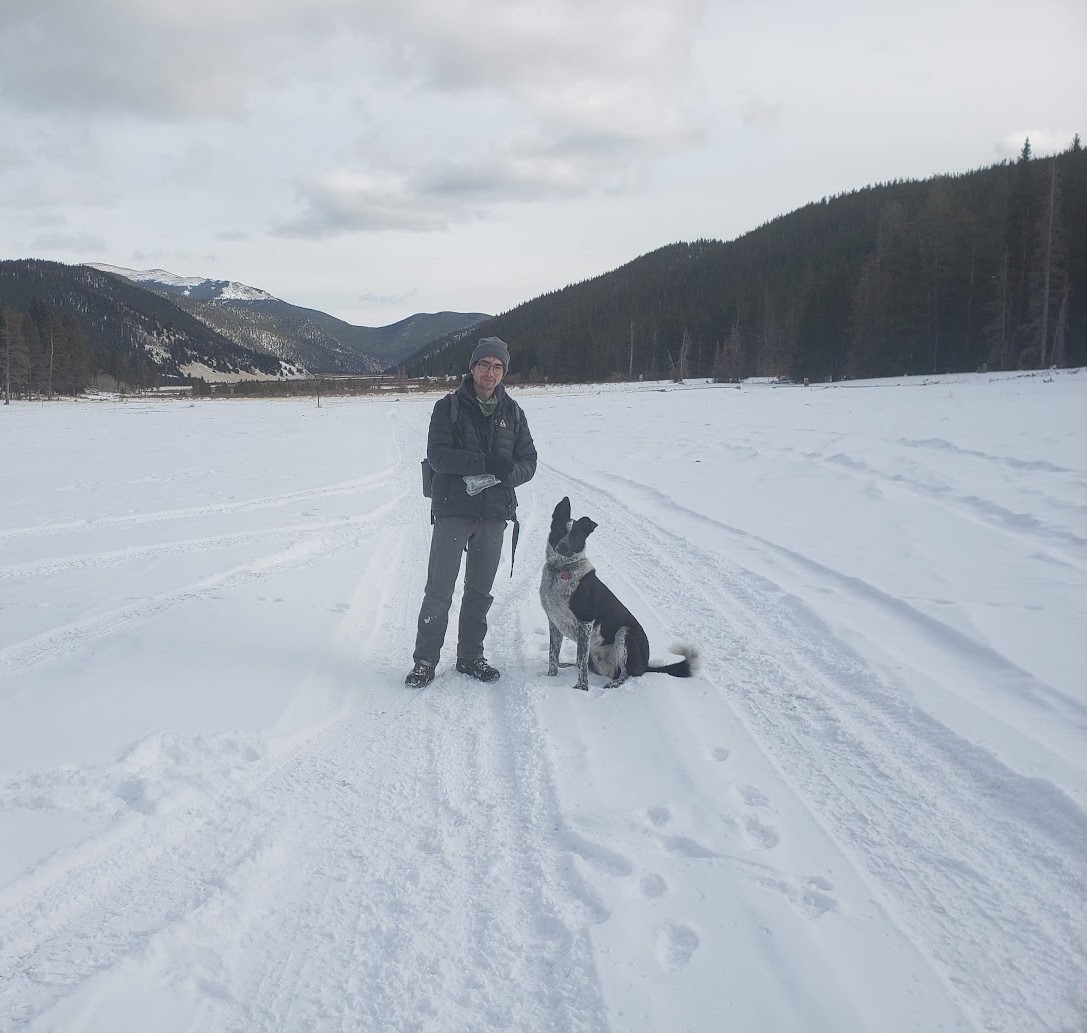
I'm a broadly trained community and ecosystem ecologist with a passion for large datasets, global change, and applied science. I'm currently a postdoctoral researcher in the Suding Lab at the University of Colorado Boulder, studying drought and fire in rangelands across the Western US.
During my Ph.D., I focused on how plant communities and ecosystems respond to changes in climatic conditions, with the goal of informing land management decisions. I'm particularly interested in the impact of precipitation variability in arid and semi-arid rangelands. Previously, I investigated the behavioral ecology of checkerspot butterflies in coastal Maine.
Selected work
Research.
I am interested in how distubances regimes and climate interact to shape plant communities and the consequences of these shifts for future ecosystem functioning. My work applies a variety of quantitative methods to experimental, observational, and remotely-sensed datasets.
Changing fire regimes
Fire impacts in the Great Basin
Fire is rapidly altering the historical sagebrush steppe ecosystem of the northern Great Basin. At the same time, climate projections predict an increase in precipitation variability — but we currently have a limited understanding of how these two drivers will interact.
Using satellite-based gridded datasets, we assessed how fire alters the relationship between net primary production and precipitation across a swath of northern Nevada. Drawing on quantitative methods from the causal inference literature, we found that as fire converts sagebrush ecosystems to annual-grass-dominated systems, this change in plant functional compostion leads to increased sensitivity of production to precipitation changes. Increased sensitivity can result in in larger inter-annual fluctuations, which in turn, have the potential to increase fire hazard, particularly under a more variable future precipitation regime. For more information see Merchant et al. 2026
Collaborators: Elisa Van Cleemput, Andrew Felton, Laura Dee, Peter Adler, Mike Koontz, Katie Suding
Fire-related plant traits
Historically, the Great Plains has been characterized by both grazing and fire — a history that may have shaped the strategies of plants in these grassland communities. We're quantifying grassland traits related to flammability and grazing, and testing whether there's a trade-off such that some species have fire-adaptive strategies while others are adapted to grazing. Can we use this information to understand the effects of land management decisions like grazing and perscribed fire?
Collaborators: Sam Ahler, Jon Henn, Advyth Ramachandran, Nancy Shackleford, Katie Suding
Fire probability forecasting
While wildland forest fires recieve much attention, fires in grasslands and shrublands acount for a large portion of the most destructive fires. Given the highly variable nature of fuels in grassland systems we expect that antecedent climate conditions can play a large role in the interannual variation in fire hazard across the Great Plains. Using seasonal climate and fuel estimates, I am applying machine learning techniques to better forecast fire proabibility in the Great Plains.
Collaborators: Jon Henn, Katie Suding
Drought impacts on plant communities
Droughts are becoming increasingly frequent and severe. I use a variety of experimental approaches to ask how droughts affect plant communities and ecosystem functioning — including how the spatial arrangement of communities interacts with drought, and how short-term extreme droughts shape rangelands.
Spatial patterns & ecosystem resilience
We implemented a long-term experiment in a Colorado grassland, simulating extreme precipitation shifts — drought (-66% of ambient) and wet periods (+66%), along with low-intensity grazing. Drought consistently reduced spatial vegetation aggregation but unexpectedly increased plant diversity, favoring stress-tolerant species. Less aggregated communities showed signs of recovery over time, suggesting a feedback mechanism where stress-adapted species influence ecosystem stability.
Collaborators: Julie Larson, Hunter Geist-Sanchez, Sarah Elizabeth Stockman, Meghan Hayden, Laura Dee, Katie Suding
Intra-season extreme droughts
To test how short-term extreme droughts affect above- and belowground processes, we used rain-out shelters to remove 100% of precipitation for five weeks in either spring or late summer. The impact of timing depended on plant community composition. Furthermore, while these droughts had only transient effects on aboveground production, effects on belowground production were stronger and more persistent. Indicating that we may be underestimating the effects of short-term droughts by focusing on aboveground responses.
Collaborators: Meghan Hayden, Katie Suding
Predicting variability in primary production
In semi-arid grasslands, landscape-level variability in primary production is critical for land management — particularly livestock grazing. Productivity can fluctuate widely across space and time, directly impacting forage availability.
Using a data-rich long-term dataset from a Colorado grassland, we investigated the drivers of spatio-temporal variability in aboveground net primary production (ANPP). Spatial variation in plant communities and soils interact to amplify these fluctuations, because different communities and soils respond to precipitation falling over different time periods — in some cases, even precipitation that fell two years ago. These effects are compounded by precipitation that varies sharply across the landscape due to localized convective storms.
Collaborators: Olivia Hajek, David Augustine, Lauren Porensky, Sean Kearney, David Hoover
Teaching & community
Outreach.
I'm enthusiastic about working with youth and adult community members on topics across the environmental and ecological sciences, and I routinely engage in hands-on educational activities.
Restoration ecology
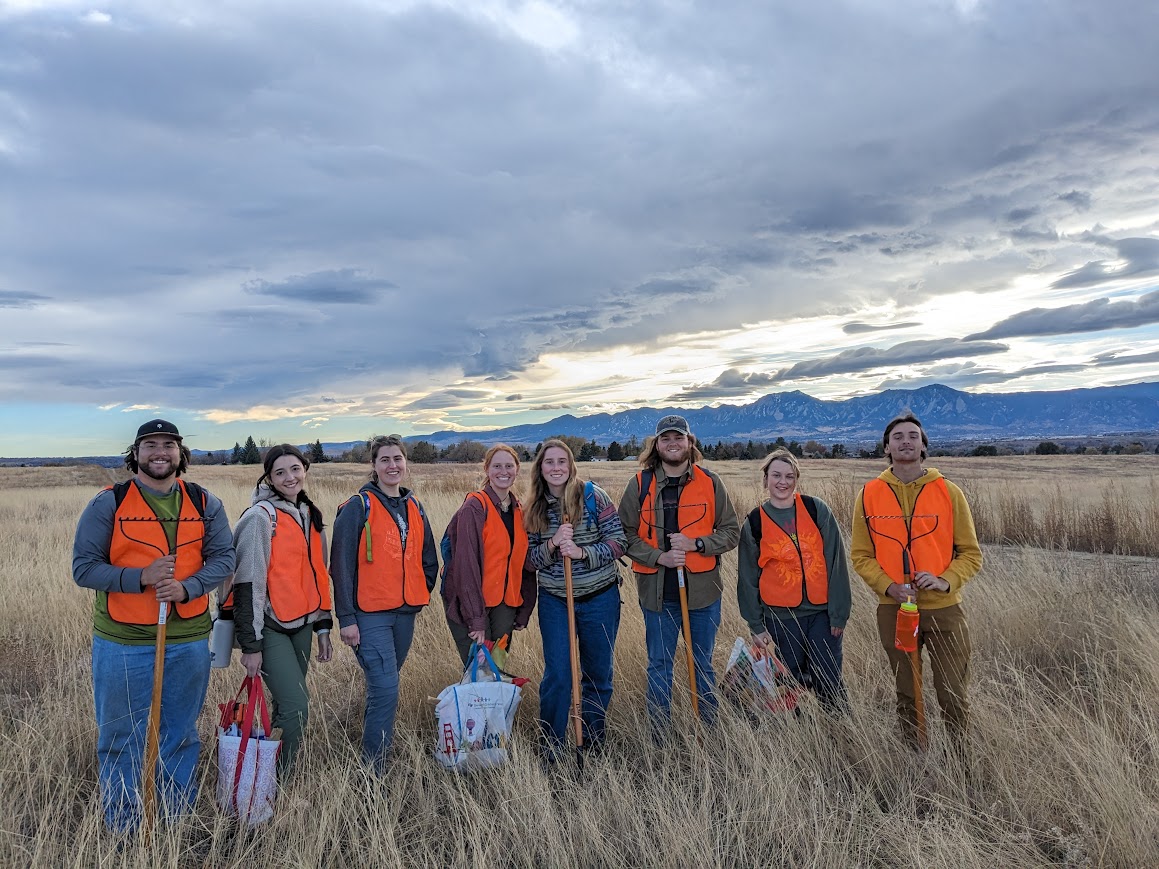
I've served as a science advisor and leader for organizations including Wildland Restoration Volunteers, which brings a wide range of groups — from families to high school students to retirees — out into the field to engage in active restoration projects.
In the fall of 2023, I worked with Katie Suding to develop a field-based restoration ecology lab for an upper-level course at CU. Students collected data and used it to develop an evidence-based restoration plan for a degraded grassland in Boulder County — and then implemented their plan in real life.
Mentoring
I find great joy in mentoring students. For several years, I've been involved in mentoring community college students through the Research Experience for Community Colleges program at CU Boulder. I've also worked with numerous CU undergraduates on independent study projects.
If you are a CU undergrad interested in this research, please reach out.